I Would Create the Universe Again Just to Hear You Say That You Love Me

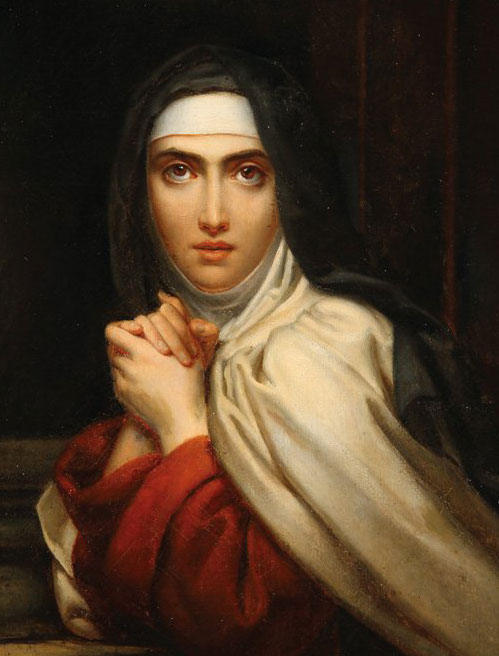
Witty Socialite, Reformer, Mystic, Doctor of the Church
St. Teresa of Avila
Due eastven at a young age, Teresa had a knack for getting into problem. She was built-in to a prominent and pious couple in Old Castille, a metropolis of Avila, Kingdom of spain. Inspired by the stories of the saints, at the age of 7, Teresa recruited her younger brother Roderigo equally a travel companion and set out for Africa where they intended to go martyrs for the faith. Their program was foiled when they were captured by an uncle, who returned them to their disgruntled parents.
Motivated past her love for God, and possibly annoyance at her father'due south strict rules, Teresa secretly entered the Carmelite Convent of the Incarnation against her father's wishes in 1535. She was the life of the party in the convent, which in those days focused on prestige and comfort. Her days were oftentimes spent charming guests with her wit and humor in the parlor and gossiping with acquaintances. In between the conversations, the servants, and the jewelry, at that place was inappreciably any time or encouragement to develop a deep spiritual life. In add-on, Teresa was plagued by serious physical and mental health issues, which she struggled with throughout her life. Living with a lukewarm spiritual life, Teresa often gave upwardly mental prayer entirely, blaming her illness for her lack of enthusiasm. But in her forties, she was encouraged past a priest to accept upwardly prayer once again. She did, but with great difficulty, and an hr of prayer became a grueling task of counting the minutes. She was constantly met with distraction. She later recalled, "I was more anxious for the hr of prayer to be over than I was to remain there. I don't know what heavy penance I would non have gladly undertaken rather than practice prayer."
As a mystic, Teresa was bombarded with supernatural experiences and visions. Jesus once said to her in a vision, "I would create the universe once more just to hear y'all say that you beloved me". Teresa suffered discouragement when rumors of her visions spread through the convent and she was the subject area of gossip and mockery. When complaining to Jesus about this injustice, He simply said, "Teresa, that's how I care for my friends". She responded, "No wonder you have and then few!"
On Prayer: "For mental prayer in my stance is nothing else than an intimate sharing betwixt friends; it means taking time frequently to be solitary with him who we know loves us. The important affair is non to think much just to beloved much and so do that which best stirs yous to love. Love is non great delight but desire to please God in everything."
At the age of forty-three, Teresa decided to reform Carmel back to its cardinal state of simplicity, prayer, and poverty. No more than frivolous conversations, jewelry, or servants. This initiative was most unwelcome and Teresa encountered hostile reactions from her own convent, the papal nuncio, other religious communities, and the surrounding towns. Every bit she traveled and founded new convents, she often entered towns at nighttime to avoid starting a riot. But Teresa, a woman with an iron will, persevered and connected to establish foundations for her new community, the Discalced Carmelites. She had a strong spiritual friendship with St. John of the Cross, who too became involved in her reform of Carmel, and they worked closely together to ready new convents and monasteries. Teresa died at the age of 67, and was named a Doctor of the Church for her writing and teaching on prayer. Her spiritual and psychological insights led her to compose a number of works on the spiritual life, including "The Way of Perfection" and "Interior Castle."
Feast Day: October xv
Source: https://giveninstitute.com/st-teresa-of-avila/
0 Response to "I Would Create the Universe Again Just to Hear You Say That You Love Me"
Post a Comment